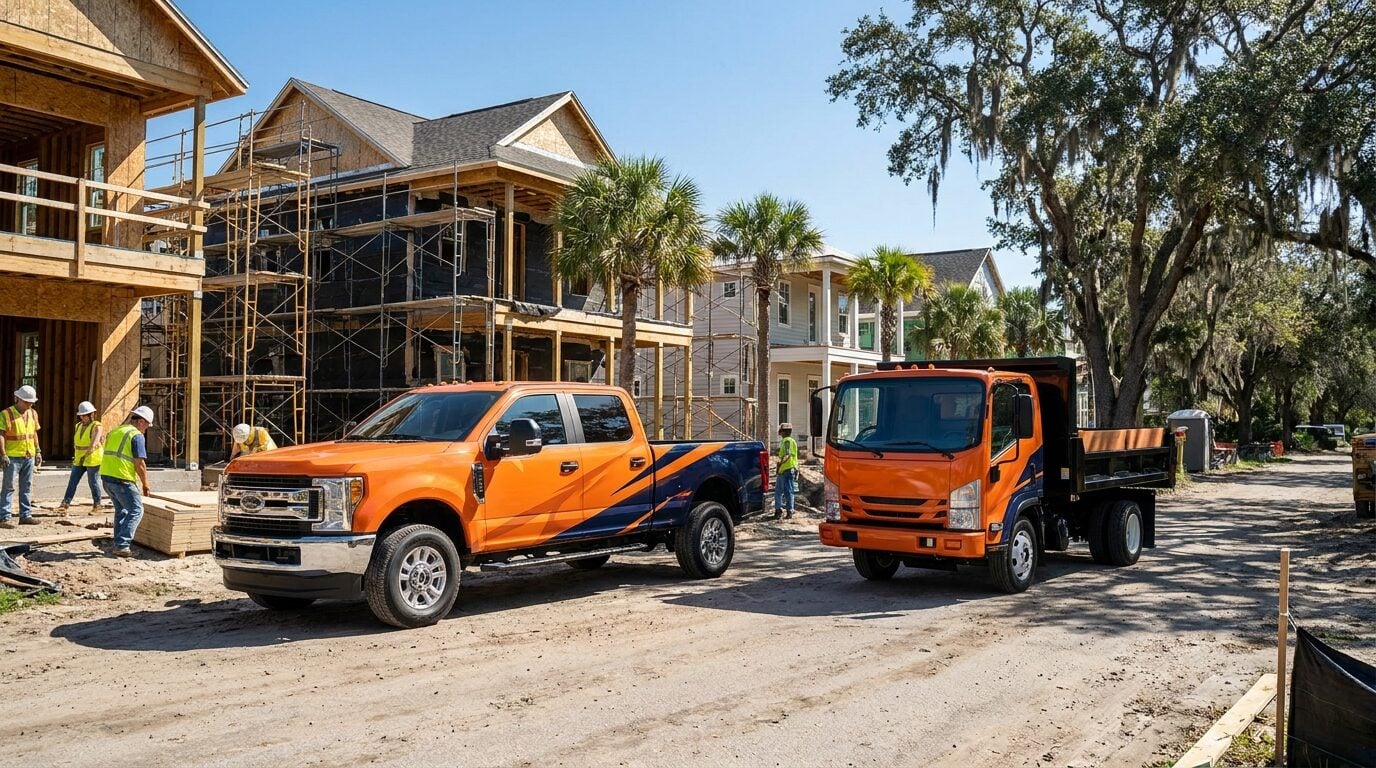
Charleston has been building steadily for years, and anyone in construction here knows what that means competitively. There is plenty of work, and there are plenty of people chasing it. On a street where three builders are active on three different lots, the one whose vehicles look like a real company has an advantage before a single conversation happens.
Construction vehicles are seen by decision-makers
This is what separates construction from most trades. Your trucks are not just seen by the general public — they are parked, all day, in front of the people who commission construction work. Developers walking a site. Homeowners in a neighbourhood watching a major renovation next door and thinking about their own. Other contractors who might subcontract to you. Architects and inspectors doing rounds.
The audience density on a job site is far higher in commercial value than a highway drive-by, even though the raw impression count is lower. That is the right way to think about return here.
What construction clients look for
Construction buyers are more sophisticated than most residential customers. They are assessing capability and reliability, not looking for a deal, and your vehicles should signal accordingly.
- Licence number — displaying it plainly reads as professional and compliant rather than promotional.
- Specialisation — “Commercial Framing” or “Site Work & Grading” tells a developer whether to bother calling. Generic “Construction” tells them nothing.
- Scale signals — consistent graphics across several vehicles say more about your capacity than any claim printed on one of them.
- A clean, restrained design — commercial buyers respond to looking organised, not to looking loud. This is one context where less aggressive design genuinely performs better.
Different vehicles, different jobs
A construction fleet is rarely uniform, and each vehicle type earns its keep differently.
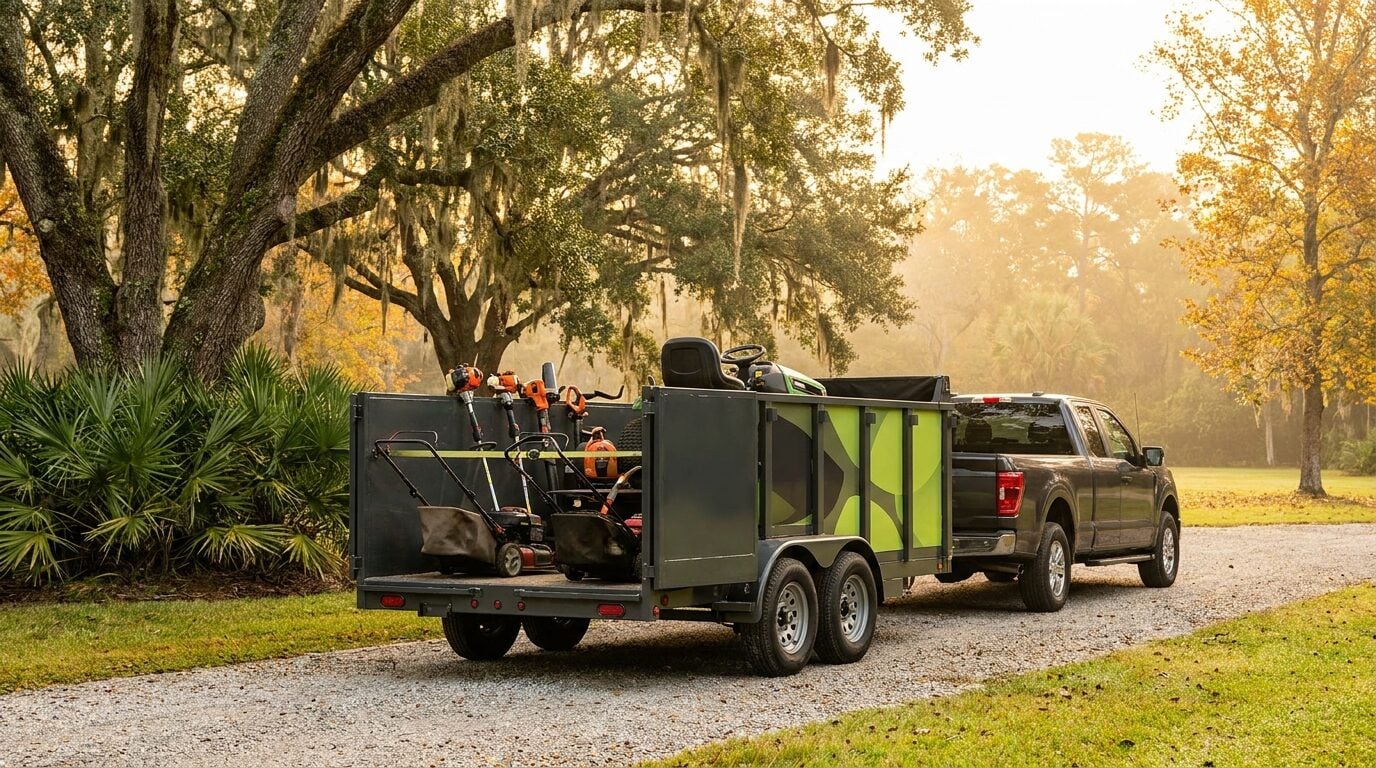
Crew-cab pickups are the most visible and most mobile. These justify the fullest treatment. Dump trucks have enormous flat bed sides that are cheap per square foot to cover and highly visible in traffic — among the best value in a construction fleet. Equipment and job-site trailers sit stationary on a lot for weeks at a time, which makes them effectively a semi-permanent site sign. Heavy plant can carry simpler identification graphics; full wraps rarely make sense on machines that live in dirt, but clear branding does.
If you are working out where to start, the priority order that usually makes sense is: the truck that visits clients, then the dump body, then the site trailer. Our guide to fleet wrap ROI for local contractors walks through the maths.
Designing for dust, mud and damage
Construction vehicles get filthy and they get scratched. Both are worth designing around.
Very light colours and white-dominant designs look superb for a fortnight and then look neglected for the rest of the month, because Lowcountry site dust is pale and shows on everything. Mid-tone and darker palettes stay presentable far longer between washes, which matters when the vehicle is your credibility on a client’s site. Keep detail out of the lowest twelve inches, where gravel and mud do their work. And on dump bodies, remember the bed sides flex and take impact from material — graphics belong on the outer panels, not anywhere in the load path.
Site signage is the same conversation
Most construction clients who wrap vehicles also need job-site signage, safety boards and hoarding graphics, and there is real value in having those produced to the same specification as the fleet. A site board that matches the trucks parked next to it reinforces the same impression twice. We handle both — see our signs and banners work.
Common questions
Can you wrap vehicles with toolboxes, headache racks and flatbeds fitted?
Yes, and it is normal for us. Some accessories may be removed to tuck film properly at the edges, which is the difference between a wrap that lasts and one that lifts. Tell us the configuration up front.
Can we phase a fleet rather than doing it all at once?
Yes, and most companies do. We finalise the design once and then work through the fleet on a schedule that suits your workload. Keeping the artwork on file means vehicle number nine matches vehicle number one.
What about leased or financed vehicles?
Wraps are generally ideal for leased vehicles because quality vinyl removes cleanly and protects the paint underneath, often leaving it in better condition than the exposed panels at handback. Check your specific lease terms, but this is one of the standard arguments for wrapping rather than painting.
Look like the company you are
Wrapstar wraps construction fleets across Charleston, North Charleston, Summerville, Ladson, Goose Creek and Mount Pleasant — trucks, dump bodies, trailers and site signage to match. Send your vehicle list and we will quote the whole programme. Request a quote or call 843-261-9727.