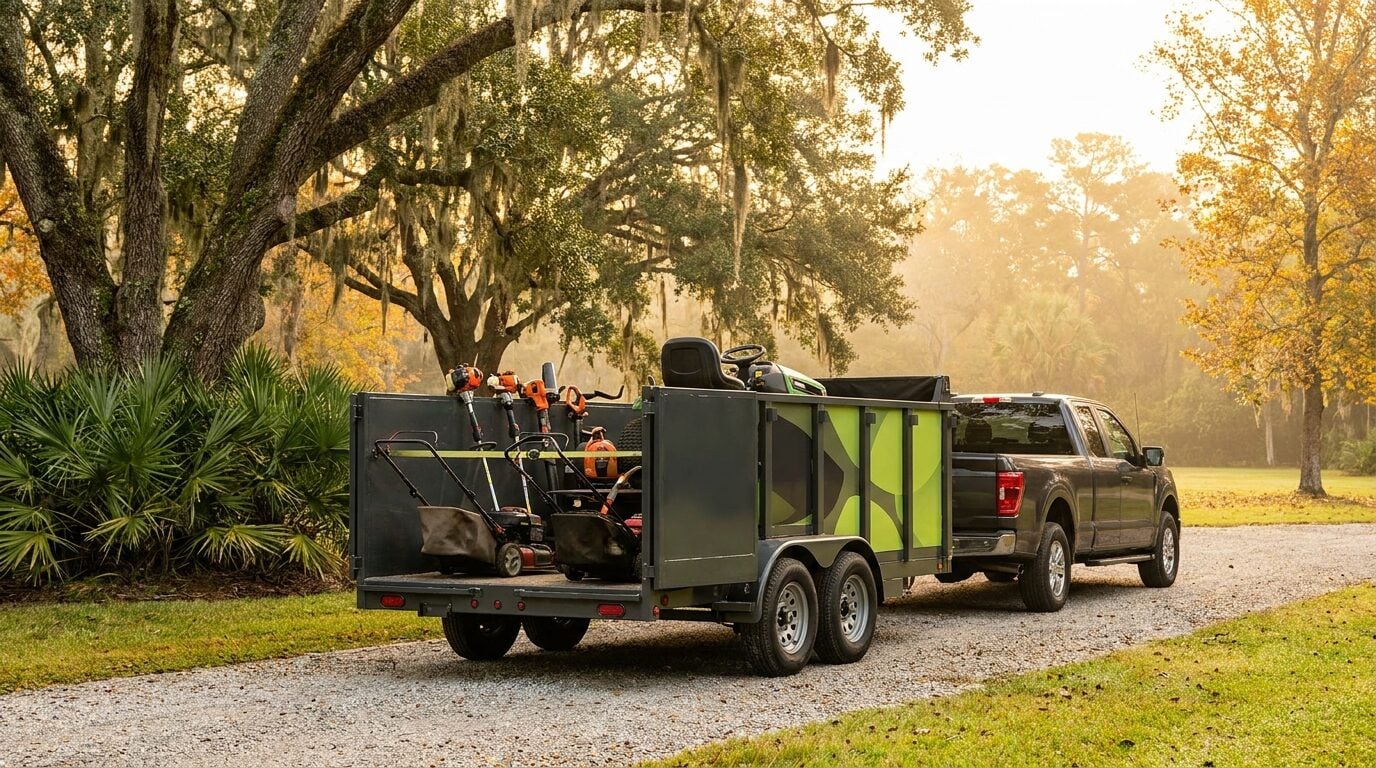
A landscaping trailer is parked in a residential driveway or on the kerb for two to four hours at a stretch, then moves a few streets and does it again. Six or eight times a day, in neighbourhoods full of people who own lawns. There is no advertising medium available to a lawn care company that puts your name in front of better-qualified prospects, more often, for less money.
The catch is that most landscaping trailers in the Lowcountry are completely blank.
The neighbour effect is the entire business case
Lawn care is bought geographically. Route density is everything — five customers on one street is a vastly better business than five customers spread across the county. And the person most likely to hire you is the one watching you cut their neighbour’s grass right now.
Every hour your trailer sits on a street, it is being seen by exactly the people who could make your route denser and your drive times shorter. A wrapped trailer converts that ambient presence into enquiries, and the enquiries it generates are the most profitable kind you can get.
What to put on an open landscaping trailer
Open trailers have less continuous surface than enclosed ones, so the real skill is using what you have properly.
- The solid side panels are your primary space. On a typical landscape trailer this is a long horizontal strip at close to eye level for anyone on the pavement — excellent placement.
- The mesh gate can take graphics via a fitted panel, and it is the surface facing traffic behind you.
- The front rail and toolbox catch the eye of oncoming traffic and are usually wasted.
- Fenders are small but sit right at the kerb where people walk past.
Keep the message simple. Company name, the two or three services you actually want more of, and a phone number large enough to read from across a lawn. Resist listing everything you are willing to do — a trailer that says “Lawn Maintenance • Irrigation • Landscape Design” in large type will beat one listing eleven services in small type every time.
The equipment problem, and how to design around it
Landscaping trailers get loaded and unloaded constantly, and mowers do not care about your graphics. Ramps drop, equipment scrapes, string trimmers rack against the sides. This is the single biggest reason landscaping wraps disappoint, and it is entirely avoidable at the design stage.
Two principles matter. Keep the logo and phone number in the upper portion of the panel, well above ramp and deck height, so that the elements you actually care about are not in the impact zone. And favour bold solid colour in the lower third rather than fine artwork, because scuffs across a flat colour field read as wear and tear while scuffs across detailed graphics read as damage.
Done that way, a landscaping trailer wrap ages gracefully rather than looking tired in year two. The broader design considerations for trailers are covered in our guide to enclosed and utility trailer wraps.
Autumn is the right time in the Lowcountry
Charleston lawns do not stop needing attention in winter, but the work changes. As Bermuda and centipede go dormant, mowing frequency drops and the mix shifts toward leaf clearance, pruning, irrigation checks, pine straw and mulch, and the seasonal cleanups that lead into spring contracts.
That shift matters for two reasons. First, autumn is when homeowners are actively reassessing who does their yard, ahead of annual contracts. Being visible during that window is worth more than being visible in July. Second, your own schedule loosens slightly, which makes it a far easier time to have a trailer in the shop for a couple of days than it will be in March.
Matching the truck
A wrapped trailer behind a plain truck is a missed opportunity, and the two are almost always seen together. Even simple matched lettering on the truck doors tied to a fuller trailer design makes the operation look considerably more established, which matters when a homeowner is choosing between you and the guy with no signage at all. Our comparison of lettering versus full wraps is a useful place to work out where to spend.
Common questions
My trailer has open rails rather than solid sides. Can it still be wrapped?
Yes. We fit rigid insert panels to the rails and wrap those, which gives you a proper graphic surface without changing how the trailer loads. It is a common solution and it looks purpose-built rather than added on.
How long will a wrap last on a working landscaping trailer?
Less than on a garaged car, honestly — these trailers work hard and live outside. With quality film and a design that keeps key elements out of the impact zone, expect several good years, with the option to replace individual panels rather than the whole thing.
Is it worth wrapping a trailer I might replace soon?
If the trailer has a couple of seasons left, usually yes — the payback period on trailer graphics is short. If you are replacing it within months, wait and wrap the new one, and we will hold the design ready.
Turn your route into advertising
Wrapstar wraps landscaping and lawn care trailers across Charleston, Summerville, Ladson, Mount Pleasant, West Ashley and Goose Creek. Send a photo of your trailer and truck and we will come back with a concept and a quote. Get started or call 843-261-9727.