Commercial Vinyl Lettering & Vehicle Decals in Charleston: When to Letter, When to Wrap
Wrapstar blog · June 2, 2026
If you’ve got a service truck, a fleet of vans, or a single work vehicle that’s doing double duty as a mobile billboard in Charleston, the question isn’t whether to brand it. It’s whether vinyl lettering is enough — or whether a full wrap will pay you back faster. At Wrapstar, we install custom vehicle lettering in Charleston SC for everyone from one-truck plumbers to multi-vehicle fleets, and the answer almost always depends on three things: how many people see your truck each week, how complex your logo is, and how long you plan to keep the vehicle. Here’s the honest version.
What we mean by “vinyl lettering” (and what it isn’t)
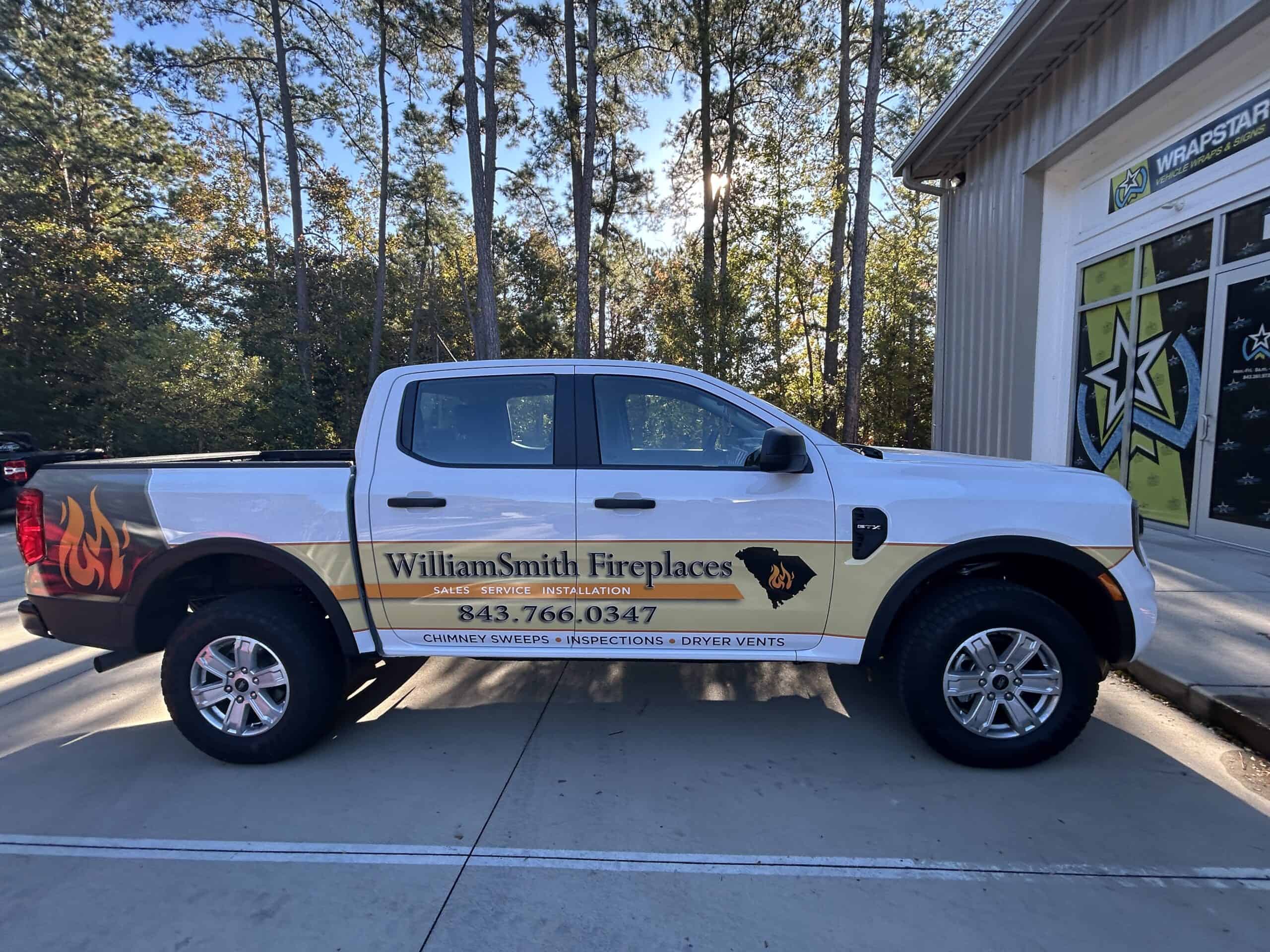
Vinyl lettering is precision-cut, premium adhesive vinyl applied directly to a vehicle’s painted surface. Lettering jobs typically include your business name, phone number, website, USDOT or licensing info, and your logo — without covering the entire body panel the way a full wrap does. Because the underlying paint shows through, lettering reads best on solid, well-maintained vehicles where the body color complements the lettering color.
A vinyl decal is the same family of material — the difference is mostly job scope. “Lettering” usually refers to text-only jobs; “decals” cover graphics, logos, and shaped images. Both use the same 3M, Orafol, KPMF, or Arlon vinyl we use on our full wraps. As we’ve written before, the material is only half the story — the install does the other half.
When custom vehicle lettering is the right call
Lettering is the right answer when most of these are true for your business:
- Your truck or van is one or two years old or newer, with paint in good shape. Lettering looks intentional on a clean vehicle; on faded paint it looks like an afterthought.
- Your brand is text-forward. A clean wordmark, your phone number in a big block, and a website — that’s a lettering job. Complex illustrations or photo imagery want a wrap or large decal.
- You’re keeping the vehicle for 3–5 years. Quality cast vinyl from 3M, Orafol, KPMF, or Arlon (the brands we install) is rated for 5–7+ years on a vertical surface in the Lowcountry climate when professionally applied.
- You want a lower-cost branding solution that still photographs and reads cleanly. Lettering and small graphics typically run a fraction of what a full wrap costs — exact numbers depend on coverage, prep, and how many vehicles, but expect lettering jobs to start in the low hundreds for a basic install and scale up from there.
- You may sell or trade the vehicle. Lettering removes more cleanly than a wrap if it’s installed correctly, with no paint damage when our team handles the removal.
When a wrap (partial or full) is the smarter spend
Here’s where we’ll tell you straight: if any of these apply, a wrap is usually the better investment.
- Your fleet is parked in high-visibility lots all day — King Street, Mount Pleasant Towne Centre, the convention center, downtown garages. A wrap turns parked time into impressions. Lettering looks great moving down the road but disappears in a parked-fleet photo. We’ve broken down the math on impressions vs. paid ads here.
- You want to color-change the vehicle to match a brand palette. Lettering won’t change the base color. A partial or full wrap can.
- Your logo uses gradients, photo elements, or finely detailed illustration. Cut vinyl handles solid colors beautifully but struggles with gradients. Printed wrap material doesn’t.
- You’re branding food trucks, box trucks, or anything with large flat panels. Big surfaces deserve big imagery. Our box truck vs. sprinter van guide walks through why that surface area changes the math.
Why the install matters as much as the design
Charleston punishes shortcuts. We’re hot, humid, salt-air close to the coast, and the sun doesn’t take days off. Lettering installed without proper surface prep — a real cleaning, panel-by-panel temperature check, the correct squeegee technique — will lift at the edges within a season. Lettering installed by a 3M Certified Graphics Installation Company on properly prepped panels will outlast the financing on the truck.
Wrapstar is a 3M Certified Graphics Installation Company and a 3M Business Certified shop. We’re also a preferred installer for Orafol, KPMF, and Arlon. That’s not a sticker we put on the wall — it’s a quarterly recertification, an audit of our materials handling, and a written warranty on the install when you use approved vinyl. Practically, it means edge sealer where it belongs, post-heat where the panel demands it, and an honest “this won’t last on that surface” conversation when the truck shows up rougher than the customer described over the phone.
The lettering checklist most shops skip
Before you book any vinyl install — with us or anyone else — make sure your shop covers these:
- Vinyl spec on the quote. If the quote says “vinyl,” ask which one. 3M IJ180Cv3 or Orafol 3551 RA cast vinyl reads very differently from a generic calendared vinyl that will start curling in 18 months.
- Surface prep included. A real install starts with isopropyl-based prep, contamination removal, and panel temperature in the install range. If they’re skipping that, walk away.
- USDOT and licensing compliance. If you’re a commercial fleet running in South Carolina, your DOT numbers have to read at a regulation height. Your installer should know this without being asked.
- Mock-up before install. Either a 3D vehicle render or a tape-out on the truck. You should see exactly where lettering lands before vinyl touches paint.
- Warranty in writing. Material warranty (from 3M/Orafol/KPMF/Arlon) plus installation warranty (from us) — separate documents, both written.
Pricing — what it actually costs in Charleston
Ranges, because every job is different: a single-vehicle text-only lettering install (business name, phone, website, two doors and a tailgate) typically runs in the low to mid hundreds. Add a logo decal on each side and a back-window graphic and you’re stepping toward the mid-hundreds to low thousands depending on size and complexity. A small fleet of four service vans, lettered consistently, often costs less per vehicle than the same individual jobs because of design reuse and a single material order.
The real question isn’t “what does lettering cost?” — it’s “what does each branded vehicle return per month?” In Charleston, a properly lettered service truck on the road five days a week sees tens of thousands of impressions across a 30-day month. The lettering pays for itself in months, not years. The deeper math is in our piece on fleet vehicle wraps and ROI for local companies.
Lettering vs. wraps — quick decision matrix
| If you… | Choose |
|---|---|
| Need text + small logo, one or two vehicles, paint in good shape | Vinyl lettering |
| Need a color change or want the truck to look like a billboard from 50 feet | Full wrap |
| Have a tight budget but want professional branding | Lettering, then upgrade later |
| Run a fleet that parks in high-visibility spots | Partial or full wrap |
| Plan to sell the vehicle in under 18 months | Lettering |
| Want photo, gradient, or illustrative imagery on the vehicle | Printed wrap |
Frequently asked questions
How long does vinyl lettering last on a Charleston vehicle?
Professionally installed cast vinyl from 3M, Orafol, KPMF, or Arlon is rated 5–7+ years on a vertical surface in our climate. Horizontal surfaces (hoods, roofs) get more UV and last 3–5. The biggest single factor isn’t the climate — it’s the installer’s prep and the vinyl spec. A bad install in cool, dry weather still fails. A good install in Lowcountry summer doesn’t.
Can I get lettering removed without damaging the paint?
Yes, if the lettering was installed on factory paint in sound condition and removed with the right technique — typically gentle heat plus adhesive remover, never razor blades on body panels. We remove lettering routinely as part of vehicle resale prep. If lettering was applied over already-failing paint or a wax-heavy surface, removal can pull primer; that’s an install-quality problem, not a removal problem.
Is custom vehicle lettering legal for South Carolina commercial vehicles?
For commercial fleets, South Carolina follows federal FMCSA standards for DOT numbers and motor-carrier identification, which require the lettering to read at minimum specified heights and contrast against the background. We handle the compliance details on every commercial install. For private vehicles, there are no statewide restrictions on tasteful branding; consult your SCDMV contact if you’ve added safety lighting or modifications that change vehicle classification.
Can you match my exact brand colors with vinyl?
Almost always. 3M, Orafol, KPMF, and Arlon together offer hundreds of stock colors, including matte, satin, gloss, metallic, and color-shift finishes. For brand-critical Pantone matches we run a small printed sample first so you can see it on actual vinyl before the install. If your brand is built around a unusual gradient or photo treatment, we’ll recommend printed material instead of cut vinyl.
Do I need to come in for an estimate?
Not necessarily. For most lettering jobs, clear photos of every panel that will get vinyl, plus your existing logo files, are enough for a written estimate. For complex layouts, fleet jobs, or anything involving a color change, we’ll want the vehicle on-site. Drop us a note through our contact page and we’ll send back the next step.
Ready to letter your truck the right way?
Wrapstar is a family-owned, 3M-certified shop in Ladson serving Charleston, Mount Pleasant, Summerville, West Ashley, North Charleston, James Island, and Goose Creek. Whether you’re branding a single service truck or a fleet of fifteen, we’ll walk through the lettering-vs-wrap decision honestly, quote both options where it makes sense, and stand behind the install. Tell us about your vehicle and we’ll come back with the recommendation we’d give a family member.
Ready to turn heads?
Free quote and design consult. Tell us what you’re wrapping and we’ll come back with options and pricing.
- Free design consult
- Financing available
- 3M-certified install
- Printed in-house
Loading the quote form… or call (843) 261-9727